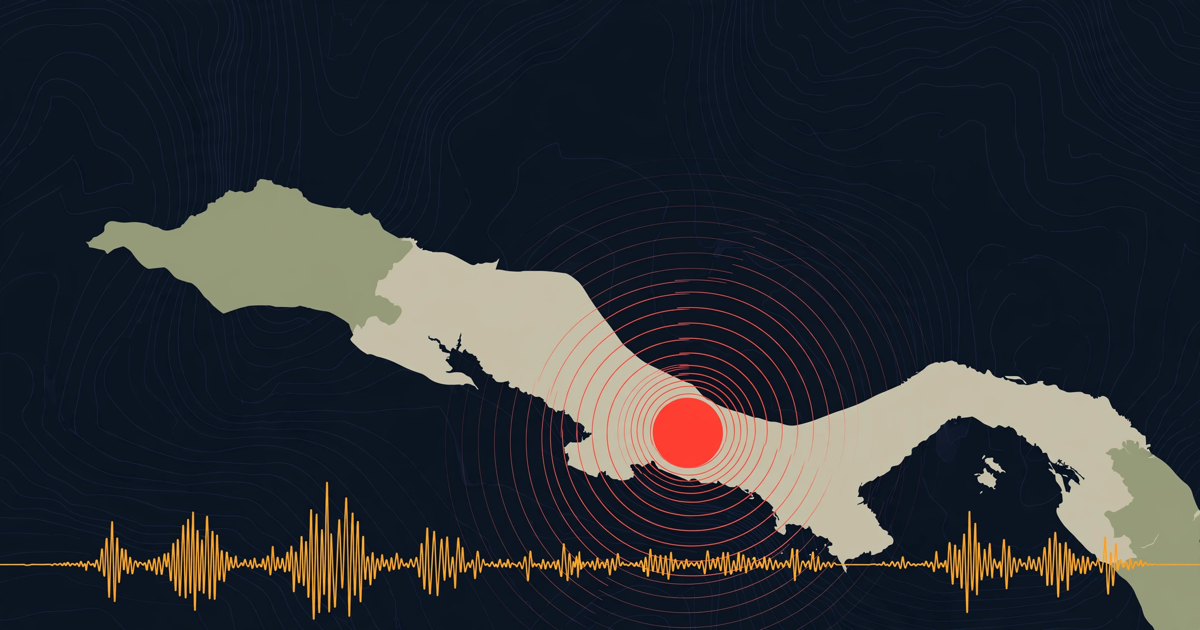
When the ground sways in Islamabad, Lahore or Delhi and nothing nearby is damaged, the first question online is usually the same: was that Afghanistan? Very often the answer is yes. But the earthquake didn't happen near the surface of Afghanistan. It happened about 200 km underground, beneath the Hindu Kush mountains.
That depth explains most of what people notice about these earthquakes: they are felt across several countries at once, the shaking is long and rolling rather than sharp, and they rarely knock buildings down. It also explains why the rare dangerous ones are dangerous for different reasons.
Why the Hindu Kush has earthquakes so deep
Most earthquakes happen in the top 20 to 30 km of the Earth, where rock is cold and brittle enough to snap. The Hindu Kush is one of the few places on land where large earthquakes keep happening far below that, typically between about 150 and 250 km down.
The reason is the same collision that built the mountains. India has been pushing north into Eurasia for tens of millions of years. Under north-eastern Afghanistan, a slab of old plate is sinking steeply into the mantle, and it keeps breaking as it sinks. The activity is concentrated under Badakhshan province, which is why so many earthquake reports name a place such as Jurm or simply say "Hindu Kush region, Afghanistan".
Why a Hindu Kush earthquake is felt from Kabul to Delhi
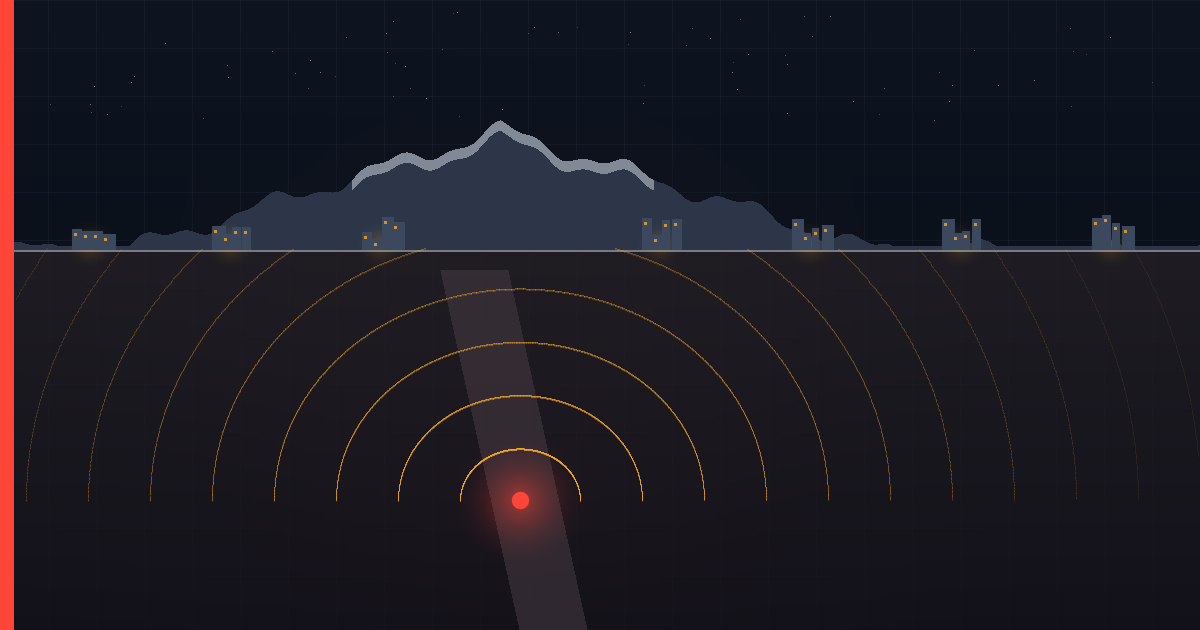
A shallow earthquake is like a blow to one spot: violent directly above, weakening quickly with distance. A deep earthquake has to travel 200 km upward before it reaches anyone, so by the time its waves arrive they have spread out over a huge area. Nobody is directly on top of it, and nobody is very far from it either.
The result is gentler shaking over a much wider region. A strong Hindu Kush earthquake is routinely felt in Kabul, Peshawar, Islamabad, Lahore, Srinagar, Delhi, Dushanbe and Tashkent within the same minute. The magnitude 7.5 earthquake of 26 October 2015, about 210 km deep, was felt more than 2,000 km away.
Two more things people notice:
- The swaying lasts. Long, slow waves travel furthest. They are felt most on the upper floors of tall buildings, which is why people in high-rise flats and offices in Islamabad, Lahore and Delhi often feel an earthquake that people on the street miss.
- Hanging things move more than the floor. Fans, lights and water in tanks swing for a while after the shaking seems to have stopped.
Deep does not mean harmless
Depth softens the shaking; it doesn't remove it. The 2015 Hindu Kush earthquake killed more than 300 people in Afghanistan and Pakistan, most of them in Khyber Pakhtunkhwa, where steep slopes, landslides and weak houses turned moderate shaking into collapses.
The comparison with 2005 shows what depth does. The 2005 Kashmir earthquake was a similar size, magnitude 7.6, but it broke close to the surface right under towns. Pakistan's official count was more than 73,000 dead.
The deadliest recent earthquakes in the region have not come from the deep Hindu Kush cluster at all:
- On 31 August 2025 a shallow magnitude 6.0 earthquake in eastern Afghanistan killed more than 2,200 people, according to Afghan authorities. It was smaller than many Hindu Kush earthquakes but much closer to the surface, under villages of mud and stone houses.
- On the night of 2–3 November 2025 a magnitude 6.3 earthquake about 28 km deep struck near Kholm, east of Mazar-i-Sharif. It killed at least 20 people, injured hundreds and damaged the Blue Mosque in Mazar-i-Sharif.
So a strong sway in Islamabad is usually a deep earthquake far away, and that is the reassuring case. The dangerous case is a shallow one close by, and in the first few seconds nobody can tell which is which.
How often the region shakes: our numbers
Our earthquake pages count every earthquake recorded within 300 km of a city over the last 12 months. As of 6 October 2026:
- Kabul: 119 earthquakes, 117 of them magnitude 4 or above. The largest was the Kholm earthquake of 2 November 2025 (UTC), which our merged record lists as magnitude 6.2, 276 km north-west of the city.
- Peshawar: 100, of which 96 were magnitude 4 or above.
- Islamabad: 29, of which 22 were magnitude 4 or above. The largest was a magnitude 4.9, 242 km west of the city, on 25 August 2026.
- Lahore: 22, of which 11 were magnitude 4 or above.
- Tashkent: 15, and Delhi: 12.
Those 300 km circles do not include all the earthquakes people feel. The centre of the deep Hindu Kush cluster is close to 300 km from Kabul and Peshawar and about 400 km from Islamabad. Many of the deep earthquakes that set Islamabad's ceiling fans swinging fall just outside the city's count, even though everyone in the city felt them. The count shows what happened close by, not everything that was felt.
What to do when you feel it
- Drop, cover and hold on until the shaking stops. Don't try to judge whether it is "only a deep one". Our guide to earthquake myths explains why running outside or standing in a doorway are worse choices.
- In a tall building, stay put. Don't run for the stairs or the lift while the building is swaying. Most injuries come from falling objects and crowded stairwells, not from the building itself.
- Afterwards, check the gas. If you smell gas, open windows and don't touch switches. Our LPG cylinder guide explains why.
- On hillsides, watch the slope for days after a strong earthquake. Our guide to landslide warning signs lists what to look for.
- Ignore "the next one is coming at" messages. No one can predict an earthquake to a date or a time.
Was that an earthquake just now?
Check the last hour near you. For Pakistan, zalzala aaj lists today's earthquakes in Roman Urdu and Urdu with times in Pakistan time, and bhukamp aaj does the same in Hindi for India. Every earthquake worldwide is on our latest earthquakes page.
What our records show, and what they miss
Our earthquake records come from instrument networks — the USGS, the European-Mediterranean Seismological Centre and others — merged so one earthquake is one record. Two limits matter in this region. First, the international catalogues record Afghanistan and Pakistan reliably only from about magnitude 4, which is why nearly all of Kabul's 119 earthquakes are magnitude 4 or above. Smaller ones happen far more often but are missing from our count. Second, agencies often disagree by a tenth or two on magnitude. The Kholm earthquake was 6.3 in the USGS catalogue and appears as 6.2 in our merged record. The method is on our about page, and the data is free to reuse from our open data page.
The short version
- Hindu Kush earthquakes happen about 150 to 250 km underground, beneath north-eastern Afghanistan.
- Because they are deep, they are felt gently over a huge area, from Kabul to Delhi, and rarely destroy towns.
- Deep does not mean harmless: the 2015 magnitude 7.5 killed more than 300 people. Shallow earthquakes close to towns, like eastern Afghanistan in August 2025, are far deadlier.
- Kabul recorded 119 earthquakes within 300 km in the last 12 months, Peshawar 100 and Islamabad 29.
- In the first seconds you can't tell deep from shallow, so drop, cover and hold on every time.