Most people imagine a burning bus as something you would have time to walk away from: a little smoke from the engine, the driver pulls over, everyone gets off. Real bus fires rarely go that way. Once the cabin catches, it can fill with thick, poisonous smoke in a minute or two. The passengers who get out are usually the ones who moved at the first sign, not the ones who waited to be sure.
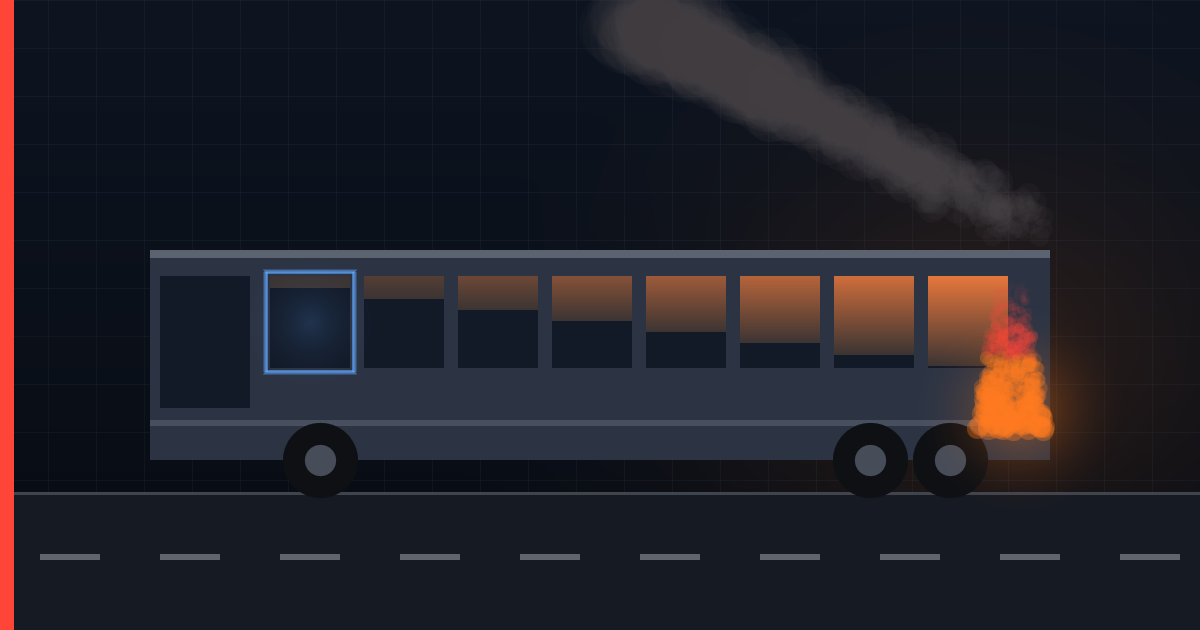
Late on the night of 23 September 2026, a sleeper bus travelling from Delhi towards Mahoba caught fire on the Yamuna Expressway near Jewar, in Greater Noida. Nine passengers died. Most were asleep when the fire started; several of the survivors escaped by jumping through the windows. Investigators said a spark in the air-conditioning system set engine oil alight. The police complaint says passengers had warned the crew about a burning smell minutes earlier, and that the warnings were ignored. The driver and conductor were arrested.
It was not an isolated case. In October 2025, two sleeper-bus fires in India killed at least 20 people each in the same month: one near Jaisalmer on 14 October, blamed on an electrical fault in the air-conditioning, and one near Kurnool on 24 October, after the bus ran over a motorcycle and the door jammed. In Pakistan, 18 people died on 20 August 2023 when a Karachi–Islamabad bus hit a pickup carrying drums of diesel and petrol near Pindi Bhattian. Reports said the whole bus was in flames within five minutes.
Why a bus fire spreads so fast
- The cabin is full of fuel. Foam seats, sleeper mattresses, curtains, plastic panels and luggage all burn. Burning foam gives off thick smoke loaded with carbon monoxide and other toxic gases. Our guide to why smoke kills before the flames explains why a few breaths can be enough to leave someone confused and unable to find the way out.
- Smoke fills from the top down. Upper sleeper berths are in the worst air first, and people lying behind curtains may not see the smoke until it reaches them.
- There are few ways out. One or two doors and a narrow aisle have to serve 40 or more people. Sleeper buses have even narrower passages between berths.
- The doors can fail. Electric and air-operated doors may stop working when the fire cuts the power, and a crash can jam a door shut. That is what passengers described in Kurnool.
- Night travel. People are asleep, shoes off, lights low. The first minute, the most valuable one, is spent waking up.
- What should not be on board. Fuel drums, spare cylinders and illegally fitted LPG or CNG kits turn a small fire into an explosion. Our LPG cylinder guide explains why a leaking cylinder is so dangerous in an enclosed space.
Bus fire safety: what to do before the journey
- Find the exits when you board. Look for the emergency door, the roof hatch and the windows marked as exits, and check whether there is a hammer next to them. If the emergency exit is blocked by luggage or extra seats, say so before the bus leaves.
- On a night bus, sit or sleep near an exit if you can choose, and keep your shoes and phone where you can reach them in the dark.
- Know who will need help. If you are travelling with a child, an elderly parent or someone who cannot move quickly, decide now who helps them and which way you will go. Among the reports in our records from the September fire is one about a son who stayed behind to help his mother, who could not walk; both died. A plan made before the journey saves the seconds that cost lives.
What to do in a bus fire
- Treat a burning smell, smoke or unusual heat as an emergency. Tell the driver to stop at once, and keep insisting. If the crew will not stop, call the emergency number.
- Get out first, then find out what happened. Do not go back for bags.
- Stay low. The cleaner air is near the floor. Cover your nose and mouth with cloth if you can, but don't stop to wet it.
- If the door won't open, use the windows. Strike a corner of the glass with the emergency hammer or any hard, pointed object — the corners break more easily than the centre. Clear the broken glass from the frame and go out feet first if you can.
- Move well away and off the road. Fuel tanks and tyres can burst. Keep everyone behind the safety barrier, not on the carriageway, where other traffic is the next danger.
- Count heads. Tell the firefighters at once if anyone is missing, and where they were sitting.
For operators and drivers
Almost every fire described above began with a warning: a smell, a fault, an overloaded electrical system or fuel carried where it should not be. Stopping to check costs minutes. Not stopping can cost lives. Working fire extinguishers, emergency hammers in place, clear aisles and exits, no fuel or cylinders as cargo, and regular checks of wiring and air-conditioning are cheap compared with a burned-out bus. Fatigue matters too. In Pindi Bhattian, reports said the driver appeared to have dozed off. Our guide to why speed makes crashes so much worse covers the other half of night-bus risk.
What our records show, and what they miss
Our records track bus fires as news reports them. Since the Yamuna Expressway fire we have logged follow-up reports of arrests and of a Supreme Court hearing on bus safety compliance. In the same fortnight we recorded a luxury bus fire on the Rajkot–Ahmedabad highway and bus fires on an expressway in Kwara state, Nigeria. And on 6 October, as this article was being written, we recorded another sleeper bus fire near Greater Noida.
Most bus fires never reach us: a fire that everyone escapes is rarely news. Causes reported in the first days are often revised once investigators finish, and casualty numbers change as the injured are treated. We use the figures that officials gave at the time. Live reports are on our fire and road accident pages, and by country on our India and Pakistan pages. The method is on our about page, and every record is free to reuse from our open data page.
The short version
- A burning bus can fill with toxic smoke in a minute or two; the first minute decides who gets out.
- Foam seats, sleeper berths, few exits, doors that fail and passengers asleep make bus fires deadly.
- When you board, find the exits and the hammer; at night, keep your shoes and phone within reach.
- Treat a burning smell as an emergency, get out low and fast, break a window corner if the door is stuck, and never go back for bags.
- The Yamuna Expressway fire on 23 September 2026 killed nine people, and passengers had reported a burning smell minutes before.