Landslides are treated as the disaster nobody could have seen coming. Often that is true — a slope let go at three in the morning with no audience and no warning anyone was in a position to read.
But a great many slopes announce themselves first. Not in the last few seconds, when nothing can be done, but over days and sometimes weeks, in small changes that look like maintenance problems rather than warnings. Doors that stop closing. A new damp patch. A fence that is no longer straight.
The reason so few people act on those signs is not stubbornness. It is that nobody ever told them the signs existed.
Why slopes fail, in one paragraph
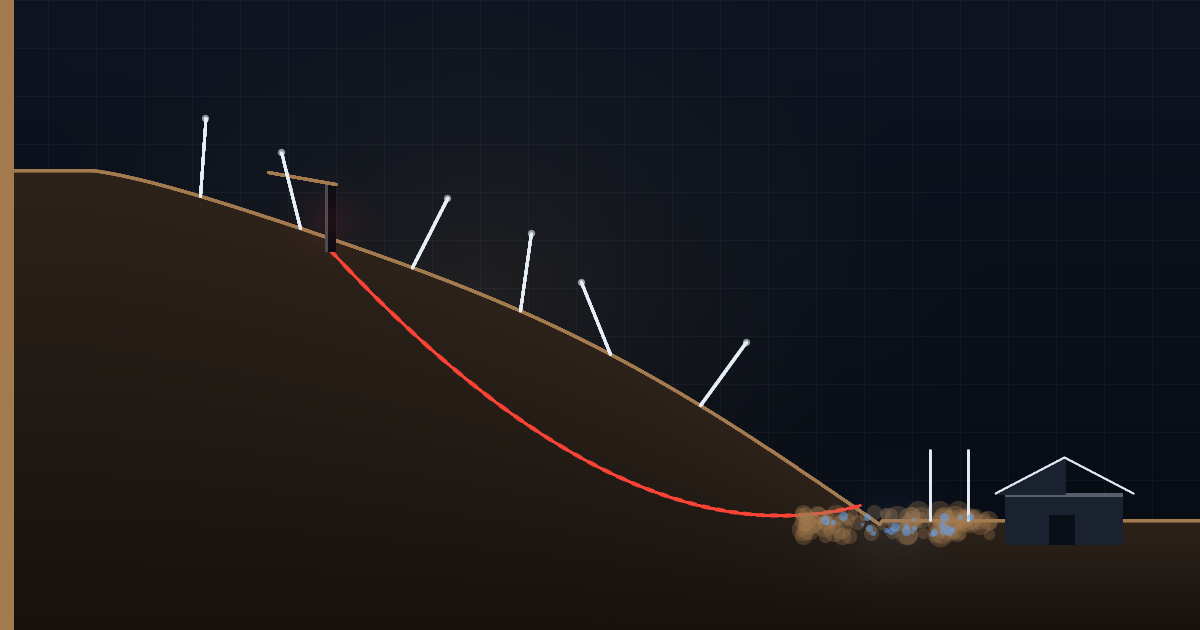
A slope stands because friction and root strength hold the soil against gravity. Water breaks that arrangement in three ways at once: it adds weight, it lubricates the surfaces the soil is resting on, and — the important one — it raises the water pressure inside the pores between soil grains, which pushes the grains apart and reduces the friction holding them together.
That is why the dangerous moment is often not the peak of the storm but a day or two after it. The rain has stopped, the sky is clear, and the water is still working its way down through the slope. It is also why a long wet spell followed by ordinary rain can be more dangerous than a single violent downpour on dry ground.
The signs, roughly in the order they appear
Days to weeks before
- New cracks in the ground, in paving, in a driveway or on the slope itself — especially cracks that run roughly along the contour of the hill rather than down it, and cracks that are getting wider.
- Doors and windows that begin to jam when they were fine before, or gaps opening where a frame meets a wall.
- Cracks in plaster or masonry, particularly ones that widen at one end, and floors that feel like they are no longer level.
- Water appearing where there was none — a new spring, a seep, a permanently damp patch at the base of a slope. This is one of the most reliable indicators of all, because it means water now has a path through the slope that it did not have before.
- Water that used to be there disappearing, which can mean the path has been blocked or diverted underground.
- Retaining walls bulging, leaning or cracking, and drains that have pulled apart at the joints.
The tilt signs
These deserve their own group because they are visible from a distance and are easy to check:
- Trees, poles, fences or gravestones leaning when they used to stand straight — or, more tellingly, leaning at different angles from one another.
- Trees with a curved trunk that bends near the base and straightens higher up. That shape is a record of ground that moved slowly while the tree kept growing upward.
- A step or bulge appearing at the foot of a slope, where material is being pushed outward.
Hours to minutes before
- A stream or river suddenly running muddy when it was clear, or carrying branches and debris.
- A stream's flow dropping sharply or stopping during rain — that can mean something upstream is damming it, and dams made of landslide debris fail suddenly.
- Sounds: a low rumble that grows, cracking timber, boulders knocking together, a noise like a train where there is no train. Debris flows are loud before they are visible.
- Utility lines snapping, or the ground perceptibly moving underfoot.
If you reach this last group, the decision has already been made for you. Move — laterally, out of the path, uphill of it if you can, and do not stop to collect anything.
Where the danger actually sits
Landslide risk is not evenly spread across a hillside, and the intuition people have about it is often backwards.
- Below a slope is more dangerous than on it. Most people killed by landslides were beneath the failure, not standing on top of it.
- Channels, gullies and dry stream beds are the paths debris flows take. They look like convenient flat ground to build on and they are the runway.
- Cut slopes behind houses — where a bench was dug into a hillside to make a level plot — are a recurring pattern in our records, especially where the cut was made without engineering and the drainage above it was never managed.
- Recently burned hillsides stay dangerous for years. Fire destroys the roots that held the soil and can leave the ground water-repellent, so rainfall that would once have soaked in runs straight off and takes the surface with it. A slope that has burned needs far less rain to fail than the same slope did before.
- Fill, spoil and tailings — ground made of material that was dumped rather than deposited — behaves far worse than natural slope in heavy rain.
What to do with a slope you are worried about
Most of what helps is unglamorous and happens long before any rain:
- Manage the water. Keep drains, culverts and channels clear, and make sure roof and surface water is carried away from the slope rather than released onto it. A blocked drain above a cut slope is a slow-motion decision.
- Do not dump spoil or rubbish over the edge. It adds weight exactly where weight is least welcome.
- Do not undercut the toe. Digging out the base of a slope to gain a metre of yard removes the thing holding the rest of it up.
- Keep vegetation. Roots are structural. Clearing a slope to improve the view is a real reduction in its strength.
- Get an engineer to look at it if you see the ground cracks or the tilt signs. This is the point at which general advice stops being useful and a specific assessment starts.
- Know the season. If you are on or below a slope in a monsoon region, the weeks of heaviest rain are when to be alert, and the days after are when to stay alert.
During prolonged heavy rain, if you are below a slope and the signs are stacking up, leaving early is the entire strategy. There is no version of this where you outrun a debris flow, and it is nearly always dark when they happen.
The flood connection
Landslides and floods are the same weather from different angles, and they compound: a slide can dam a river and then release it all at once. If you are preparing for one you should read the other — our guide to why shallow water kills covers the part that catches most people, and why drowning is silent covers what happens when floodwater wins.
What our records show, and what they miss
Landslides sit in an unusual position in our data. Large ones reach us through official channels — the UN's GDACS system and European weather warnings — but the small, local, single-house slide that kills a family and never leaves the district has no feed anywhere. Those arrive only if a journalist writes them up.
So our landslide records are a mixture: reasonably complete at the top end, badly incomplete at the bottom, and thinnest exactly where hillside settlement is densest and local press is sparsest. They are detections, not occurrences. The full explanation of that bias is in how we track every incident on Earth, and the about page lists which of our incident types have official feeds and which do not.
You can browse the archive on the incident record, check records by country, download it from the data page, or set free alerts for your area before the season rather than during it.
The short version
Slopes usually give notice, and the notice looks like household maintenance: jamming doors, new cracks, a damp patch that was not there, a fence gone crooked. Water is what breaks a slope, and the danger runs on after the rain stops. If you are below the slope rather than on it, you are in the more dangerous place — and if you can hear it, you are already out of time to think.
This article reflects established landslide-hazard guidance from geological surveys and disaster-management agencies. It is general information and not a stability assessment of any particular slope; a slope you are worried about needs a qualified engineer, not an article.