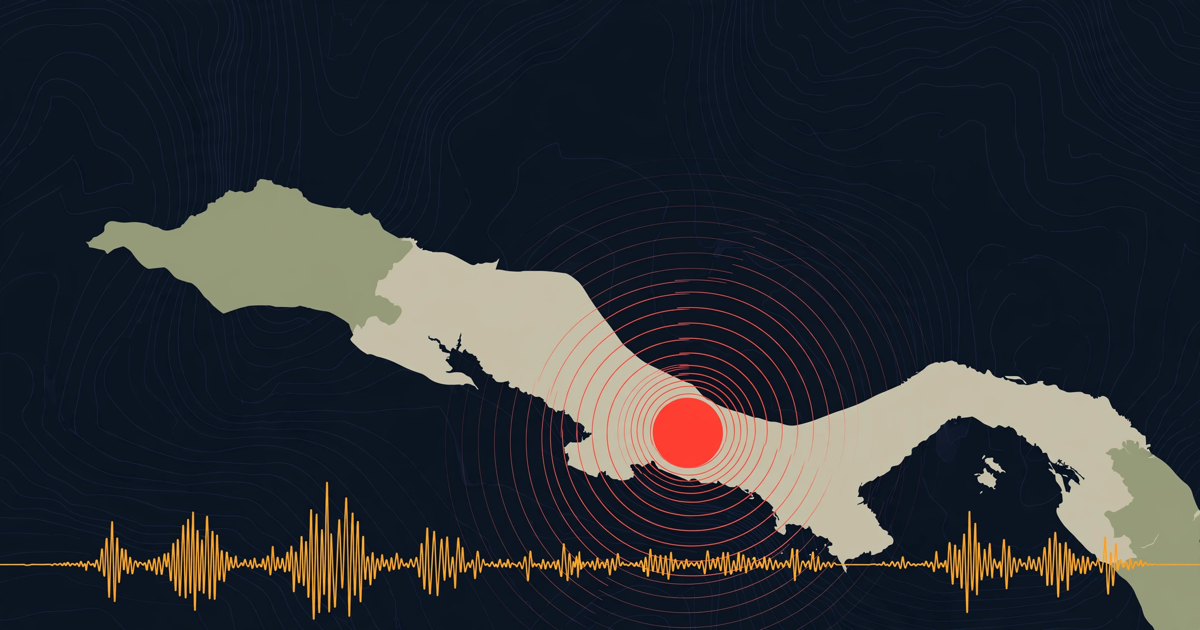
A magnitude 7.7 earthquake struck south-central Panama on Friday 9 October 2026. The United States Geological Survey (USGS) puts the epicentre 12 km west-south-west of Pitaloza Arriba, at 7.587 degrees north and 80.769 degrees west, with a shallow depth of 12.6 km. The USGS reviewed time was 17:56 UTC. A shallow earthquake of this size is felt strongly over a wide area, and the first reports from Panama described damage in provincial towns, evacuations in the capital, and a tsunami check that was stood down later the same day.
Panama earthquake: the verified facts
The core facts come from the USGS event page for this earthquake. It lists the magnitude as 7.7, the status as reviewed, and the depth as 12.6 km. Early reports in any large earthquake often give slightly different magnitudes while seismologists are still working with partial data. Where numbers differ, the reviewed figure from the responsible scientific agency is the one to use, and that is the figure used throughout this article.
Depth matters as much as magnitude. An earthquake at 12.6 km is close to the surface, so more of its energy reaches buildings, roads and slopes instead of being absorbed on a longer path through the earth. That is why a shallow magnitude 7.7 can damage weaker buildings near the epicentre while also being felt as a long, rolling motion in high-rise buildings much further away. Soil, building quality and the direction the fault moved then change the outcome street by street, which is why one town can lose walls while another nearby only cracks plaster.
BBC News, reporting from the region, placed the epicentre about 10 km from Pitaloza Arriba in south-central Panama and described building damage and collapses in Penonome and Sona. It also reported evacuations in Panama City. At the time of that report, no casualties had been reported. That wording matters: no casualties reported at that stage is not the same as a final official toll, and this article does not treat it as one. In the first day after a large earthquake, confirmed figures usually come from Panama's own emergency and health authorities, and they can change as damaged areas are reached and checked.
The tsunami check, and why it was stood down
Large shallow earthquakes under or near the sea can move the seabed and displace water, which is why tsunami checks begin quickly even before the full picture is clear. In this case, tsunami warnings were initially issued for neighbouring countries, and the US Tsunami Warning System later confirmed there was no threat. The Panama Canal authority said the canal was unaffected, according to the BBC report. For readers on the coast, the lesson is not that warnings are exaggerated. The lesson is that the warning system is designed to move first and confirm second, because a real tsunami can arrive before a perfect measurement does. If a warning is issued for your coast, move to high ground first and wait for the official all-clear, rather than waiting to see the sea change.
Our live incident map follows official feeds including the USGS and NOAA tsunami messages, so a stood-down warning looks different from an active one when old screenshots circulate hours later.
What to expect in the next few days
Aftershocks are normal after an earthquake of this size. They are smaller earthquakes on or near the same fault system as it adjusts, and they can continue for days or weeks. Most are much smaller than the main shock, but an aftershock can still knock loose material that the first earthquake cracked, bring down a weakened wall, or frighten people back into the street at night. Anyone in the affected area should treat a damaged building as unsafe until it has been checked, even if it is still standing. Do not re-enter a building with visible structural cracks, a shifted staircase, jammed doors that were not jammed before, or a leaning wall, just to collect belongings.
The practical safety steps are the same ones used after every large earthquake, and they are worth stating plainly:
- During shaking: drop, cover and hold on. Stay away from glass, shelves and anything that can fall.
- After shaking: check yourself and people nearby for injuries, then move carefully, watching for broken glass and fallen wires.
- Expect aftershocks: be ready to drop and cover again, and keep shoes, a torch and essential medicines within reach at night.
- Avoid damaged buildings: aftershocks can finish what the main earthquake started.
- Use official updates: follow Panama's emergency authorities and the USGS aftershock information rather than forwarded messages with no source.
The Panama country page gathers incidents recorded there, and the earthquake tracker shows how this event sits alongside other significant earthquakes recorded in the same period.
Why early numbers need care
Within hours of a major earthquake, social media usually carries three kinds of numbers: the magnitude, a damage count, and a casualty figure. Only the first of those comes quickly from a scientific network. Damage and casualty figures depend on people reaching places, checking buildings and reporting through an official chain, and that takes time in rural areas and at night. That is why this site separates what is officially recorded from what is merely reported, and why our incident statistics carry a warning to read the note under each chart before quoting a number. A fast number with no source is not information; it is a rumour with digits.
The same caution applies to video. Clips labelled as Panama will circulate whether or not they were filmed there. Before sharing, check whether the USGS time and the official reports line up. If they do not, do not pass it on.
For background, our explainer on why Hindu Kush earthquakes are felt from Kabul to Delhi covers depth and distance in plain language. More reporting is on the articles page.
What our records show, and what they miss
Our records show this earthquake as a reviewed USGS event: magnitude 7.7, shallow, in south-central Panama on 9 October 2026, followed by an official tsunami check that ended with no threat. What our records miss is just as important. A seismic network can locate an earthquake within minutes, but it cannot tell us whether a school, clinic or bridge is safe, count the injured, or measure damage to a village road. Those facts come only from Panamanian responders on the ground, and they arrive more slowly. Until they do, the honest summary is the narrow one: a large shallow earthquake, damage reported in at least two towns, evacuations in the capital, no casualties reported at the time of the first major reporting, and a tsunami threat that was checked and stood down.
The short version
- A magnitude 7.7 earthquake struck 12 km west-south-west of Pitaloza Arriba, Panama, on 9 October 2026 at 17:56 UTC, at a shallow depth of 12.6 km (USGS).
- Building damage and collapses were reported in Penonome and Sona, with evacuations in Panama City; no casualties had been reported at the time of the BBC report.
- Tsunami warnings were checked and later stood down, with the US Tsunami Warning System confirming no threat and the Panama Canal reported unaffected.
- Aftershocks are expected; avoid damaged buildings and follow official Panamanian and USGS updates rather than unsourced messages.
- No final official casualty or damage toll is stated here, because none was confirmed in the sources checked.