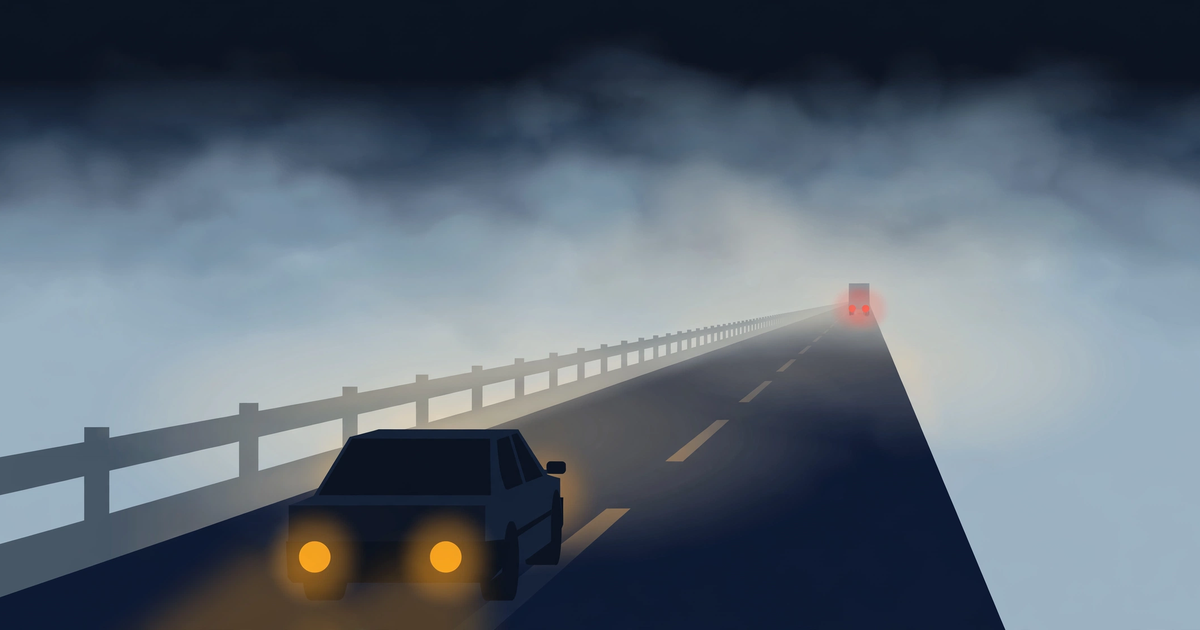
Ask drivers what to do in fog and most give the same answer: slow down a little and switch the headlights to full beam. The slowing down is right. The full beam is exactly wrong — in fog, a bright beam bounces straight back off millions of tiny water droplets and turns the windscreen into a white wall. And "a bit slower" is not what kills people on foggy motorways. What kills them is driving at nearly normal speed a few metres behind the vehicle in front, until the moment that vehicle is suddenly stopped.
Every winter the same pattern repeats across the Punjab plains. Fog rolls in after midnight, visibility at dawn drops to a few metres, and by morning the motorway police are closing whole sections of the M-2, M-3, M-4, M-5 and M-11 while rescue teams untangle multi-vehicle pile-ups. In one recent case, police reported 30 vehicles piling up at three fog-bound locations on the M-2 and M-1 in a single morning, with at least 20 people injured. None of those drivers set out to crash. They drove into fog the way they drive in clear weather, and found out too late that fog changes every rule.
Why fog is worse than it looks
Fog is a cloud at ground level: tiny water droplets that scatter light in every direction. Three things follow, and all three fool drivers:
- Distance disappears. In clear weather you judge a gap by the size of the vehicle ahead. In fog, a truck 100 metres away and a car 20 metres away can look like the same faint shape. Drivers routinely believe the gap in front of them is bigger than it is.
- Speed feels slower than it is. With nothing rushing past at the edge of your vision, your brain under-reads your speed. People who feel they are doing 60 are often doing 90.
- A stopped vehicle looks like a moving one. Fog hides brake lights until you are close, and a vehicle parked on the shoulder can look like it is sitting in your lane. Many fog deaths are collisions with vehicles that were never moving at all.
The maths is unforgiving. At 100 km/h a car covers about 28 metres every second. If you can see 25 metres ahead, you have less than one second between spotting a stopped truck and reaching it — less time than it takes to move your foot to the brake pedal.
Why one crash becomes twenty
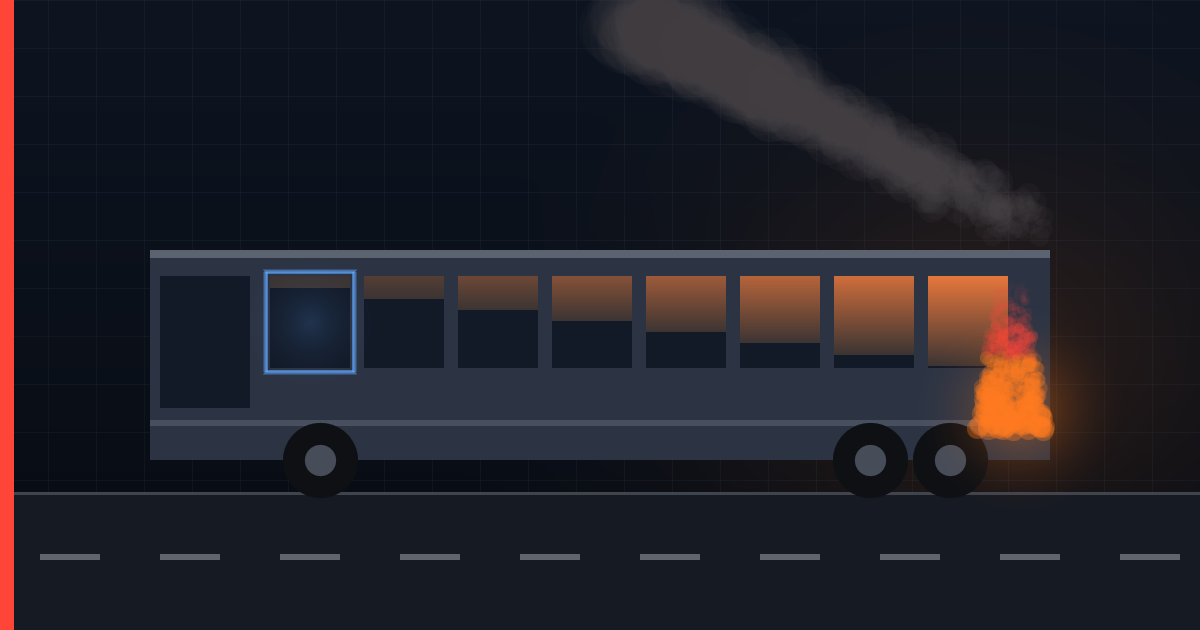
A pile-up is a chain reaction. The first driver brakes hard for something nobody behind can see. Every following driver gets the message a second later than the one in front, still travelling faster, with less room. By the fifth or sixth vehicle there is no gap left at all. That is how one skid becomes 20 or 30 vehicles, and why the National Highways and Motorway Police treat dense fog as a closure problem rather than a driving-tips problem: when visibility falls below a safe level, they shut the motorway, because no amount of care makes fast traffic safe in 20 metres of visibility.
The closures are routine and announced. In past fog seasons the motorway police have closed stretches of the M-2 (Lahore–Islamabad), M-3, M-4, M-5 and M-11 for hours at a time, and the Pakistan Meteorological Department issues fog forecasts for named motorway sections, sometimes warning of dense fog lasting until 11 in the morning. A closed motorway at 6am is not an inconvenience to route around. It is the authorities telling you the road cannot be driven safely yet.
Driving in fog: what actually helps
- Slow down before the fog, not inside it. Brake gently while you can still see. Entering a fog bank at speed and braking hard inside it is how the chain reaction starts.
- Use low beam and fog lights — never high beam. Fog lights sit low and shine under the fog. High beam reflects straight back and blinds you. Motorway police give the same advice every season: fog lights on, speed down.
- Make the gap much bigger than feels necessary. Watch the vehicle ahead pass a fixed point and count. If you cannot count slowly to four before you pass the same point, you are too close for the visibility you have — and in thick fog even that may not be enough.
- Follow the road, not the car ahead. The driver in front may be drifting, lost or stopped. Use the lane markings and the line at the road's edge as your guide, and hold your lane: police warn that lane-changing in fog is a direct cause of serious accidents.
- If you have to stop, get completely off the road. A stationary car in a live lane is the classic first link in a pile-up. Pull well onto the shoulder or off the road entirely, switch on the hazard lights, and get everyone out and behind the safety barrier.
- Keep your own glass clear. Wipers on, demister running. A windscreen fogged from the inside cuts your visibility as surely as the fog outside.
When the right decision is not to go
Most fog tragedies involve journeys that did not need to happen at that hour. The motorway police advise travelling between about 10am and 6pm in fog season, when visibility is at its best, and avoiding unnecessary night and early-morning travel altogether. Their helpline, 130, gives current closure information before you set out.
If you are already on the road and the fog closes in, the safe move is to leave at the next interchange and wait in a town, a service area or any lit, populated place — not to creep along a hard shoulder, and not to stop in a lane with your hazards on and hope. And if the motorway is closed, use the alternative route the police suggest or delay the trip. A fog closure usually lifts by mid-morning. A pile-up does not.
What our records show, and what they miss
Our road accident records fill up every winter with crashes from the fog belt, and Pakistan's page shows the season arriving each year. But the records understate fog in two ways. First, "fog" only appears in a report when the crash is big enough to make the news — usually a pile-up involving many vehicles. A two-car crash at dawn on a district road is filed as an ordinary accident, if it is reported at all. Second, daily totals from rescue services mix every cause together: on one fog-bound day in January 2026, Punjab's Rescue 1122 attended more than a thousand road crashes across the province, most of them not on motorways and not all caused by fog. What the records can show is the pattern, not the exact toll: the crashes cluster in the same weeks, on the same plains, in the same early hours. Speed makes all of it worse — our guide to why a little more speed is a lot more danger explains the physics.
The short version
- In fog, high beam blinds you — use low beam and fog lights, and slow down before you enter the fog, not inside it.
- At 100 km/h you cover about 28 metres a second; if you can only see 25 metres, you cannot stop in time. Leave a gap you can count to four.
- Pile-ups are chain reactions: one hard brake becomes twenty crashes. Never stop in a live lane — get off the road and behind the barrier.
- Motorway closures in fog are a safety signal, not an obstacle. In fog season, travel between 10am and 6pm where you can, and check the Motorway Police helpline 130 before setting out.