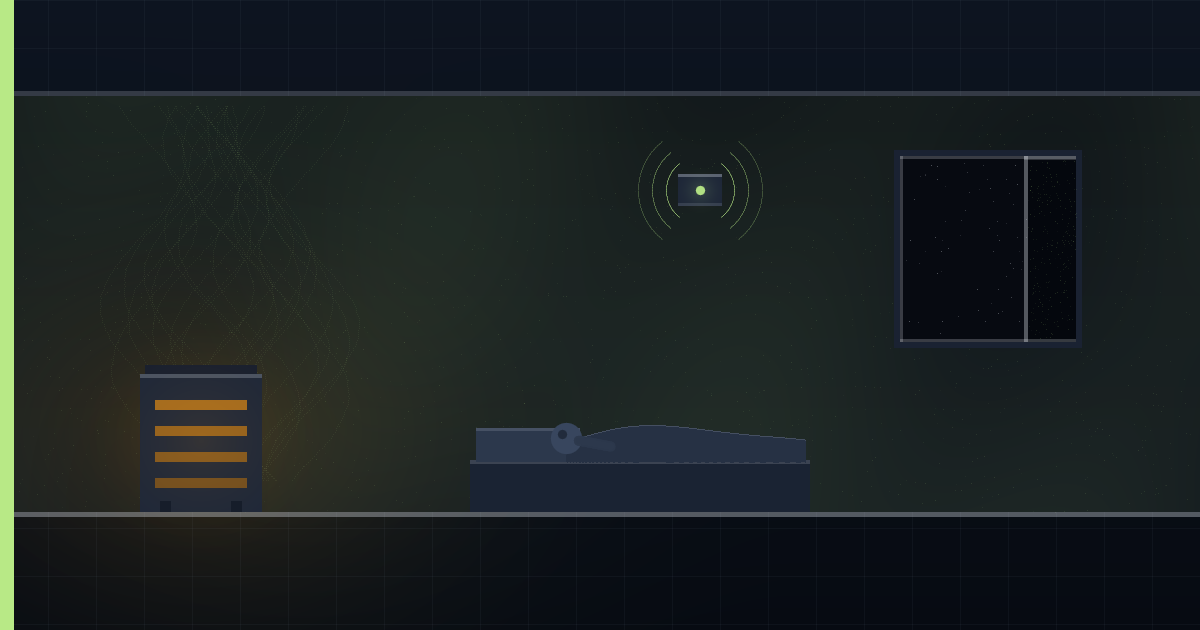
Every winter, in cold countries and in warm countries that get a few cold weeks, whole families are found dead in their homes with no sign of what happened. No fire, no smoke damage, no forced entry. The heater was on, the room was sealed against the cold, and everyone went to sleep.
Carbon monoxide is the only common household hazard that gives you no warning at all. Not a faint one — none. It has no smell, no colour and no taste, and the first symptom is one you will mistake for something else.
Why it kills so efficiently
Your blood carries oxygen on a protein called haemoglobin. Carbon monoxide binds to that same protein far more readily than oxygen does — by a factor of a couple of hundred. So even a small concentration in the air wins the competition, and the blood fills up with something that cannot be delivered to tissue.
Two things follow from that, and both matter.
First, you suffocate while breathing normally. There is no shortness of breath, because your lungs are working and the reflex that makes you gasp responds to carbon dioxide building up, not to oxygen running out. Nothing tells your body to panic.
Second, it accumulates. A low concentration over a long night does what a high concentration does quickly. This is exactly why it kills people who are asleep — the exposure is long, and the one defence, noticing you feel wrong and leaving, is switched off.
The symptoms, and the one that gives it away
Early carbon monoxide poisoning looks like flu, or like a bad headache, or like food poisoning:
- Dull, persistent headache — usually the first sign
- Nausea, sometimes vomiting
- Dizziness, unsteadiness
- Tiredness that does not match the day
- Confusion, difficulty concentrating, poor judgement
- Shortness of breath on exertion
Any of those alone is unremarkable, which is the problem. Here is what separates it from actual flu:
- There is no fever. Flu-like symptoms without a temperature deserve suspicion in a heated, closed room.
- More than one person is unwell at the same time — and often the pets are too. Birds and small animals show it first, because they are smaller.
- Everyone improves after leaving the house, and gets worse again on returning. This is the single strongest indicator, and it is the question to ask when a household is repeatedly "coming down with something" in winter.
The cherry-red skin colour some people have heard about is a late sign, and often absent. Do not wait for it.
Where it comes from
Carbon monoxide is produced whenever a carbon fuel burns without enough oxygen — gas, wood, coal, charcoal, kerosene, petrol, diesel. In a working appliance, the exhaust goes outside. Poisoning happens when combustion goes wrong, or the exhaust does not leave.
- Gas room heaters, especially older or unflued ones, and above all when left burning overnight in a closed bedroom. This is the classic winter fatality.
- Instant gas water heaters installed inside bathrooms. A small sealed room, a burner running, and a person unconscious before they understand anything is wrong. This arrangement is common in parts of South Asia and it is one of the deadliest.
- Charcoal and coal braziers brought indoors during a cold snap. Glowing charcoal produces enormous amounts of carbon monoxide with no flame and almost no smoke, which is precisely why people think it is safe to bring inside. It is not. This kills more reliably than almost anything else on this list.
- Generators — during a power cut, run in a garage, a stairwell, a courtyard or just outside a window. A generator produces carbon monoxide in quantities that can kill through an open doorway.
- Blocked or damaged flues. A bird's nest, a collapsed liner, a chimney sealed during renovation. The appliance is fine; the exhaust route is not.
- Vehicle engines running in an attached garage, even briefly, even with the garage door open.
The belief that undoes all of it
"I left a window open, so it is fine."
A gap at a window does not reliably clear carbon monoxide. It depends on wind direction, on temperature difference, on where in the room the gas is being produced, on whether there is any cross-flow at all. On a still, cold night — the exact conditions in which people run heaters — there may be almost no air exchange through that gap.
Ventilation is not a safety device. It is a factor that sometimes helps. The safety devices are: a correctly installed and serviced appliance, a clear flue to the outside, and an alarm.
The alarm
A carbon monoxide alarm is the only thing that detects this before you do, because you cannot detect it at all. It costs about what a cheap heater costs and lasts years.
- Fit one in every room with a fuel-burning appliance, and one where people sleep.
- Mount it at roughly head height when sleeping — carbon monoxide mixes fairly evenly with air, so ceiling mounting is not required and floor level is not useful.
- Keep it a metre or so away from the appliance itself, or brief normal start-up emissions will make it cry wolf until somebody removes the battery.
- Test it monthly and note the replacement date. The sensor expires, typically after seven to ten years, and an expired alarm looks exactly like a working one.
- A smoke alarm does not detect carbon monoxide. They are different sensors for different hazards, and you want both.
If you suspect it right now
Do these in this order. Do not reorder them to save time.
- Get everyone outside into fresh air — people and animals. Do this before investigating anything.
- Turn the appliance off and open doors only if you can do it on the way out, in seconds. Do not search the house for the source.
- Call emergency services and your gas supplier from outside.
- Get medical attention even if everyone feels better in the air. Blood tests can confirm exposure, and treatment is oxygen. Feeling better outdoors does not mean the exposure was harmless.
- Do not go back in until someone qualified says the appliance is safe. People die returning to fetch something.
If someone is unconscious, get them out and start resuscitation in fresh air. Rescuers are a large share of carbon monoxide casualties — the same pattern that makes confined spaces so lethal. The atmosphere that dropped them will drop you at the same rate.
What our records show, and what they miss
Carbon monoxide deaths are close to invisible in global data. No agency anywhere publishes a live feed of them. They surface as local news — a family found in a flat, a couple in a bathroom — and only when someone reports it.
In our archive they appear under gas leaks, and the count in the incident archive is a small fraction of the real number. Coverage also follows the press: the same event is far likelier to be recorded where local media is dense. Our method page sets out which hazards have official feeds and which do not, and how we track every incident on Earth is honest about the size of that gap. The underlying records are free to reuse with attribution from our open data page, and per-country figures are at countries.
The short version
- No smell, no colour, no warning. You cannot detect it without an alarm.
- Flu symptoms with no fever, affecting several people or the pets at once, improving when you leave the house — treat that as carbon monoxide until proven otherwise.
- Never bring a charcoal or coal brazier indoors. Never run a generator inside or beside an opening.
- An open window is not ventilation and is not protection.
- Fit an alarm where people sleep, test it monthly, and replace it before the sensor expires.
- If you suspect it: everyone out first, call from outside, and do not go back in.
The reason this hazard deserves an article of its own is not that it is common. It is that every other danger in the home announces itself — smoke, flame, a smell of gas, a noise. This one does not, and the only warning you will ever get is one you have to install yourself.
Related reading: why LPG sinks and what not to touch, and why smoke kills first in a house fire.