The bed starts to move at 3 a.m. The lights are out, something has fallen in the next room, and you have perhaps a minute to decide what leaves the house with you. That minute is not the time to search drawers for batteries. It is the time to grab the one bag already packed by the door.
No scientific agency can tell you when that minute is coming. The US Geological Survey is blunt about it: no scientist has ever predicted a major earthquake, and a real prediction would need the exact date, place and size in advance. Probabilities over years are possible; appointments are not. Preparedness is the part of earthquake safety that is entirely in your hands.
Why the bag is built around 72 hours
Emergency planners in several countries use the same benchmark: after a serious emergency, you may need to look after yourself for several days before normal services fully return. US FEMA puts it at at least 72 hours, and its Ready.gov checklist is built on that idea — your own food, water and basic supplies in one or two containers you can actually carry.
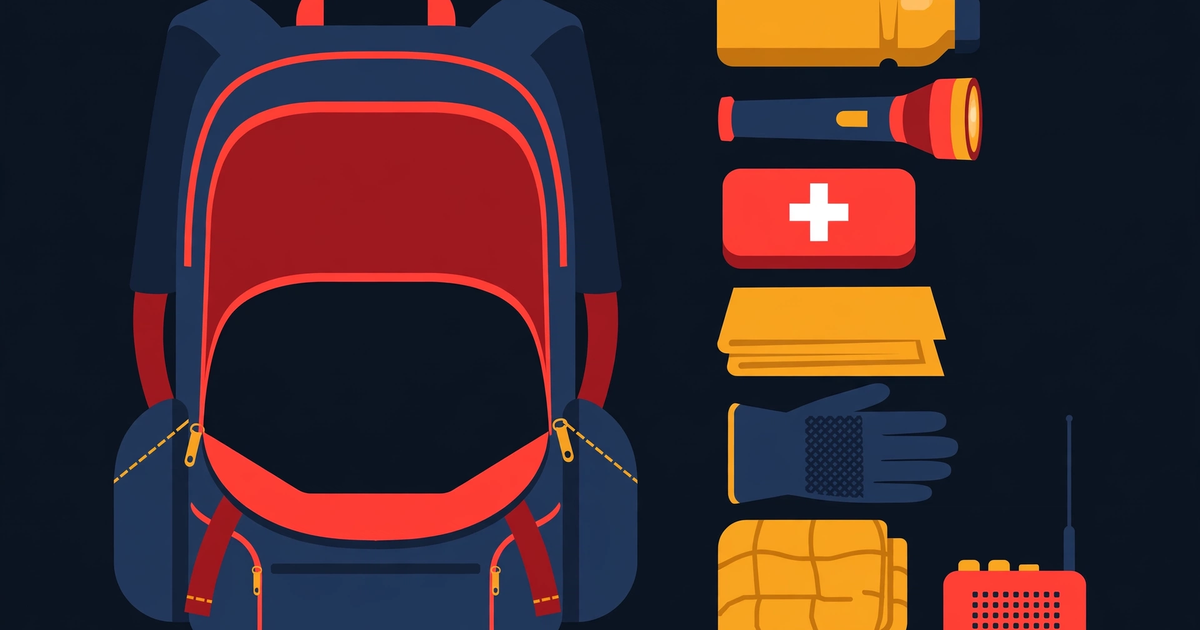
Pakistan's National Disaster Management Authority (NDMA) gives the same basic advice in its earthquake guidelines: keep an emergency kit somewhere easy to reach, stocked with water, non-perishable food, first aid supplies, a torch, batteries and a battery-powered or hand-crank radio, plus sturdy shoes, gloves and a blanket. When official guidance agrees that closely, it is a good place to start.
The earthquake go-bag, item by item
Every item below earns its place by solving a specific problem in the first three days. If an item solves no problem, it is weight.
- Water. Ready.gov's figure is one gallon per person per day — roughly four litres — covering drinking and basic sanitation. Water is heavy, so many households store the full supply at home and keep a smaller amount in the grab bag itself.
- Food that needs no cooking. A three-day supply of non-perishable food per person, plus a manual can opener if any of it is tinned. This food is not meant to be enjoyable; it keeps everyone steady until shops and kitchens work again.
- Light and a voice. A torch with spare batteries, and a whistle. After a strong earthquake, power is often the first thing to go. A whistle carries far further than a tired voice if you ever need to signal for help.
- First aid, and the medicines you rely on. A basic first aid kit for cuts and knocks, plus any medicines you personally rely on and spare glasses if you wear them. Pharmacies may be closed or unreachable for days. If anyone is hurt beyond basic first aid, call your local emergency number or get to a hospital as soon as it is safe to travel.
- Dust masks and sanitation. Collapsed plaster and rubble fill the air with dust; a dust mask makes breathing in it far easier. Moist towelettes, garbage bags and plastic ties — all on the Ready.gov list — cover basic sanitation when water is scarce.
- Documents and cash. Copies of identity documents and important family papers, sealed in a waterproof, portable container, and some cash in small notes. Card machines and networks fail early in disasters; paper and cash do not.
- Phone power and a radio. A charged power bank and charging cables, and ideally a battery or hand-crank radio. When mobile networks congest, official information still moves by radio — and text messages get through overloaded networks better than voice calls, as our earthquake tracker advises.
- Tools and warmth. A wrench or pliers to turn off utilities if officials advise it, a warm blanket or sleeping bag for each person, a complete change of clothes, and sturdy shoes. NDMA adds gloves — rubble and broken glass are not handled safely with bare hands.
The small bag by the bed
The American Red Cross adds a refinement most checklists miss: a small bed-kit, kept at the bed itself. Earthquakes do not check the clock, and a night earthquake means crossing a dark floor that may be scattered with broken glass — the Red Cross notes that cut feet from glass are among the most common earthquake injuries. Sturdy shoes by the bed, a torch, your glasses, a dust mask and a whistle mean the first ten steps of the emergency are already solved.
Where the bag lives
A go-bag buried under storage boxes is just storage. Ready.gov's rule is simple: keep the kit in a designated place, ready to grab if you have to leave quickly, and make sure every family member knows where it is. Near the door you would actually use is best. Ready.gov extends the idea: a smaller kit where you work, and basic supplies in the car — because an earthquake does not promise to find you at home.
This week's magnitude 7.7 earthquake in Panama sent people out of buildings and into the streets within moments. In that first movement, nobody packs; they leave with whatever is already within reach.
Children, grandparents and pets
The core list is the same for every household; what changes is the margin around it. Ready.gov suggests adding infant supplies where relevant — formula, bottles and nappies — and comfort items such as a small game or book, because a frightened child with something familiar copes better through a long night. For older family members, think about mobility and routine: spare glasses within reach, any medicines they rely on kept with the kit, and a plan for who helps them move. Pets need their own small addition — food and extra water, per the same Ready.gov checklist. None of this needs specialist equipment, just thinking about your actual family instead of a generic one.
Keep the bag alive
A go-bag is not finished when it is packed; it is finished when it is checked. Ready.gov's maintenance advice is unglamorous and essential: store food in a cool, dry place, replace anything that expires, and rethink the kit at least once a year as the family changes. Batteries die quietly. Children outgrow clothes. Medicines rotate. Ten minutes twice a year keeps the bag honest.
What our records show, and what they miss
Our records show the background hum nobody feels but every seismometer does: this site has logged tens of thousands of earthquakes in 2026 so far, tracked continuously from official networks such as the USGS and EMSC. The Islamabad earthquake page shows how that global activity looks from one city's doorstep, and our Pakistan page gathers everything recorded there. What the records miss is the only part that will matter to your household: whether your building stood, whether anyone was hurt, and what your street needed in the first three days. No feed measures that. A packed bag is how a household covers the gap between the earthquake the instruments record and the help that eventually arrives. Read more about how our tracking works and the open data behind it.
The short version
- Nobody can predict an earthquake's day or hour — the USGS says exact prediction has never been done — so the bag has to be packed before you need it.
- Build around 72 hours: roughly four litres of water per person per day, three days of no-cook food, torch, batteries, whistle and a first aid kit.
- Add the things people forget: copies of documents in a waterproof pouch, cash, any medicines you rely on, spare glasses, a power bank, and sturdy shoes.
- Keep a small bed-kit — shoes, torch, glasses, dust mask — because night earthquakes mean walking over broken glass in the dark.
- Store the bag where everyone can grab it, and check it twice a year so the food, water and batteries are still good.