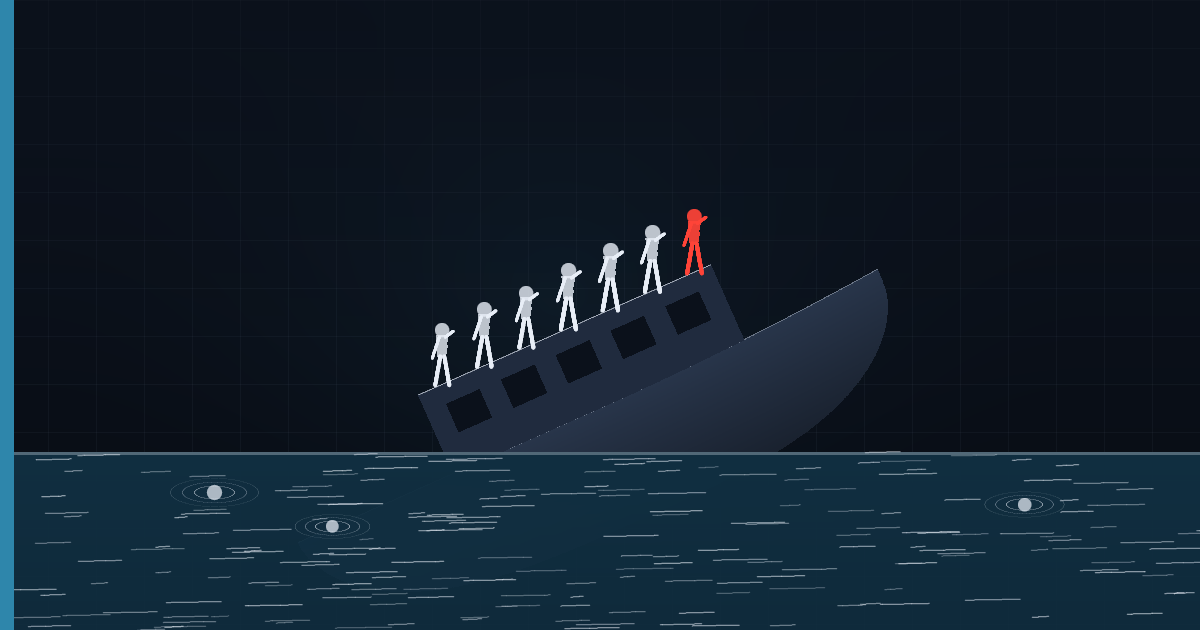
Almost every ferry and passenger-boat disaster in the world reads the same way afterwards. The boat was overloaded. There were no life jackets, or they were stowed somewhere nobody could reach. It capsized in under a minute. And a large share of the people who died could swim.
That last part is the one worth sitting with, because "I can swim" is the reason most people getting on an overloaded boat feel fine about it.
Why swimming ability barely matters
Drowning after a capsize is usually not a contest between you and the water. It is one of these instead:
- You are inside. Enclosed lower decks and cabins fill in seconds, in the dark, upside down, with people moving the wrong way. Swimming is irrelevant if you cannot find the opening.
- Cold water shock. Sudden immersion below roughly 15°C triggers an involuntary gasp and a minute or two of uncontrollable fast breathing. If your head is under when the gasp happens, you inhale water. This is a reflex, not a skill, and strong swimmers have it too.
- Other people. A person in panic climbs whatever is nearest, and in open water that is you. Drowning people do not wave and shout — that is covered in why drowning is silent — they push down on anything solid.
- Clothes, cargo and distance. Wet clothing, a bag you would not let go of, a shore that looked close from the deck and is a kilometre away.
- The hull. A capsized boat drifts, and being under it is worse than being beside it.
Overloading does not look like overloading
This is the heart of it. The boat that sinks is very rarely the first overloaded trip. It is the five-hundredth. Everybody on board has made this crossing before, at this crowding, and arrived.
What changes on the day is not the number of people. It is that a margin which had been shrinking for years finally runs out — a swell, a turn, a squall, everyone standing up at once as the shore comes into view.
Two pieces of physics explain why the end is so sudden.
Weight high up. Passengers on the roof or upper deck sit far above the waterline. The higher the load, the less the boat resists a lean. A hull that would shrug off a wave with cargo low down will keep going over with the same weight on the roof.
Water that has already come aboard. Once there is loose water inside — bilge, rain, a wave over the side — it runs downhill every time the boat leans, which pushes the lean further, which moves more water. This is why a capsize is not a slow tilt you can respond to. The boat leans, hesitates, and then goes over faster than a person can stand up.
Before you get on
You will not always have a choice. Where there is one, these are the things that actually change the odds:
- Look at where people are sitting, not how many there are. A crowded lower deck is a different boat from a crowded roof.
- Find the life jackets before you sit down. Not to be careful — to learn whether they exist and whether you could reach them. If they are locked in a box or buried under cargo, they are decoration.
- Wear it if you can. A life jacket you are holding is useless. Nobody has ever successfully put one on while a boat was going over.
- Sit near open air. Outside deck, near a rail or a wide opening. The cost of an enclosed seat is that it is a room you have to get out of.
- Know which way is out from where you are sitting, before anything happens. In the dark and at an angle, you will not work it out then.
- Night and bad weather multiply everything. The same boat, the same crowd, at night in a squall, is a different risk entirely.
If it starts to go
- Get outside immediately. Not to the highest point — to open air. Everything else is secondary to not being inside a hull.
- Do not climb to the high side. When a boat lists, the instinct is to move away from the water, and a crowd doing that adds weight exactly where it worsens the roll.
- Leave your bag. This is the decision people regret and it is made in one second.
- Get clear of the hull once you are in the water, then stop swimming.
- Hold something that floats and stay with the boat. Wreckage keeps you up and makes you findable. Swimming for a shore you can see is the single most common fatal decision after a capsize.
- If the water is cold, keep still and stay together. Movement pumps warm blood to the skin and speeds heat loss. Huddling with others is warmer and easier to spot.
- Ride out the first minute. The gasping and racing heart of cold shock pass. People who understand that this is temporary keep their head above water long enough for it to.
Helping someone else
The rule from lifeguarding holds and it is uncomfortable: reach or throw, do not go. Extend something, throw something buoyant, but entering the water to grab a panicking adult is how single drownings become double ones. That pattern — the rescuer dying alongside the person they went in for — is the same one that makes confined spaces so lethal.
What our records show, and what they miss
Boat and ferry disasters are one of the clearest examples of a hazard with no official live feed anywhere in the world. No agency publishes a real-time stream of capsizes. Maritime investigation bodies publish reports months or years later, and only for a fraction of incidents — almost never for the wooden passenger boat on a river crossing, which is where most of these deaths happen.
So everything in our maritime accident records comes from news reporting, which means coverage follows media attention rather than events. A capsize with two hundred aboard is reported worldwide; the same boat with twelve aboard, on the same river, often is not reported at all. Our method page lists which hazards have official feeds and which do not, and what the world does not publish has the full per-type breakdown with a CSV.
The records themselves are free to reuse with attribution from our open data page, and the per-country view is at countries.
The short version
- Swimming ability is not the variable. Being trapped inside, cold shock and panicking crowds are.
- Overloading is normal right up until the trip where it is not — the margin runs out, it does not warn you.
- Weight up high and loose water inside are what turn a lean into a capsize in seconds.
- Sit near open air, find the life jackets before you sit, and wear one if you can.
- In the water: get clear of the hull, hold something that floats, stay with the boat, and do not swim for shore.
- To help someone: reach or throw. Do not go in.
None of this fixes the actual problem, which is that the boat should not have left the bank with that many people on it. That is a decision somebody else made. Knowing where the exit is and what a life jacket is worth is the part that stays with you.