Almost everything the average person believes about crowd disasters is wrong, starting with the word used to describe them.
News reports call them stampedes. The word conjures panicking animals running blindly, trampling whatever is underfoot. It suggests the crowd lost its head, and that the people who died were caught in a rush they should have avoided. Nearly every part of that picture is false, and the falseness is not harmless — it moves blame onto the dead and away from the decisions that killed them.
Here is what actually happens in a fatal crowd, how to recognise one before it closes around you, and what to do if it does.
People do not die by being trampled
In the overwhelming majority of crowd disasters, the dead are not trampled and they do not die on the ground. They die standing up, held upright by the bodies pressed against them, unable to expand their chest enough to breathe.
The medical term is compressive asphyxia. Breathing requires your ribcage to move. Sustained pressure from the front and back — the kind produced when a dense crowd surges even slightly — stops that movement. Consciousness goes in around twenty-four-three seconds; death follows in a few minutes. Victims are often found upright, and post-mortems show no significant trampling injuries at all.
This is why survivors describe the same thing: they could not draw breath, they could not lift their arms, and they could not move their feet, all while standing in what looked from outside like a crowd simply waiting.
Panic is the myth that survives everything
The second false belief is that these events are caused by mass panic — that someone shouted, everyone bolted, and the crush followed.
Crowd researchers have looked at this repeatedly, and the finding is consistent and counter-intuitive: crowds in disasters are usually cooperative, not hysterical. People help strangers. They try to lift the fallen. They stay to pull others out. In many fatal crushes there was no panic at all before the deaths — the crowd was moving normally, then the density crossed a threshold and physics took over.
Panic, where it occurs, is usually the result of the crush rather than its cause. Yet the panic story appears in reporting within hours, because it is simple and because it comfortably implies the crowd did it to itself.
Density is the variable that matters
Crowd safety comes down to one number: how many people are standing on each square metre.
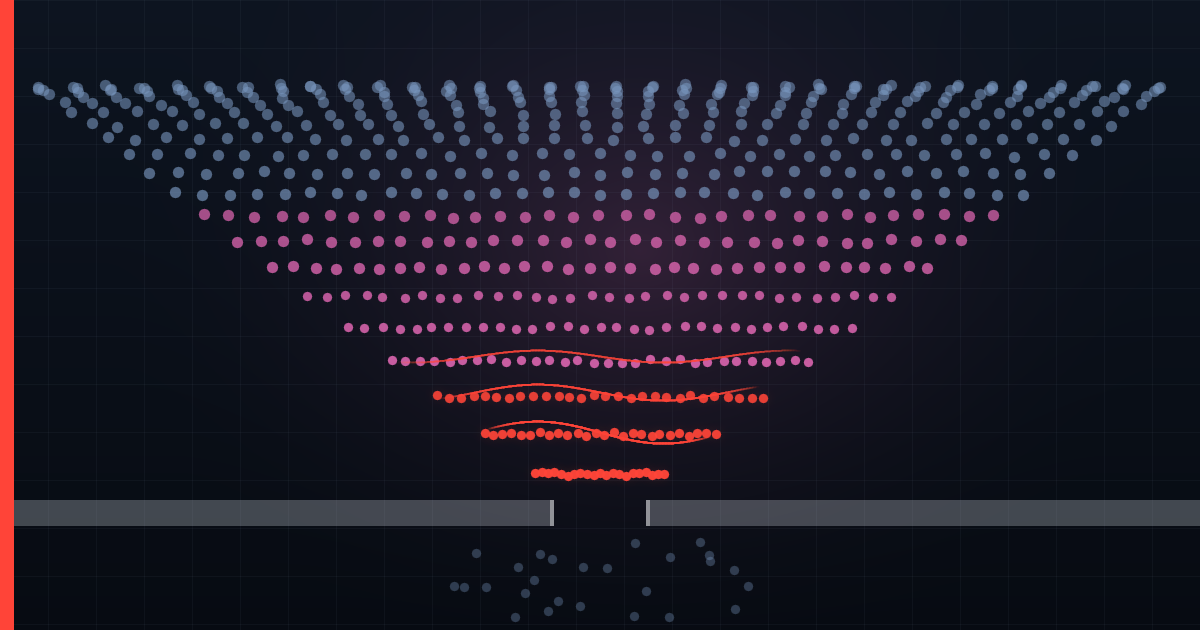
Up to about four people per square metre, a crowd is still a collection of individuals. You can choose your direction. You can stop. Somewhere around five per square metre, that stops being true — you are in continuous contact with the people around you and you move when they move. Above roughly six, individual control is gone entirely and the crowd starts behaving like a fluid.
Two things happen at that point, and both are lethal.
Shockwaves. Pressure from one side travels through the packed bodies as a visible, felt wave, sometimes over long distances. People report being lifted off their feet and carried metres without taking a step. Each wave concentrates force somewhere in the crowd, and where it concentrates, chests stop moving.
Progressive crowd collapse. When one person goes down at high density, they leave a void. The people behind, still under pressure and unable to see, fall into it. That creates a larger void, and the collapse propagates outward. Nobody in the crowd chose to push. Most of them do not know anyone has fallen.
What actually causes them
Crowd disasters are, almost without exception, failures of design and management rather than failures of behaviour. The recurring causes are unglamorous and entirely predictable:
- Bottlenecks — a wide flow of people meeting a narrow gate, corridor, tunnel or stairway.
- Counterflow — two streams of people trying to pass through the same space in opposite directions.
- Gates opened late, which lets pressure accumulate outside before release.
- Slopes and steps inside a dense crowd, where a single stumble starts a collapse.
- A single entry or exit serving a space that filled through several.
- No way to count or cap how many people are already inside.
Read that list again and notice that none of the items are about the crowd. They are all about the venue. This is the part that ought to change, and it is the part that changes slowest.
Recognising it before it closes
You will not get a warning from the organisers. You have to read the crowd yourself, and there are three reliable signals.
- You are touching people on all sides and did not choose to be. This is the threshold. A crowd where contact is continuous and involuntary is a crowd that can kill, even though at this moment it feels merely uncomfortable.
- You cannot move freely in the direction you want. If moving means waiting for a gap that the crowd gives you, you have already lost the ability to leave quickly.
- You feel waves travelling through the people around you. This is the final signal, and it means the crowd is already behaving as a fluid. Leave immediately, sideways, toward the edge.
The window between "uncomfortable" and "cannot breathe" is often only a few minutes. Almost everyone who dies in a crush passed through the first signal and stayed.
If you are already in it
These are the things crowd-safety specialists consistently advise. None of them require strength, and several are the opposite of instinct.
- Stay on your feet. This overrides everything else. Falling is what kills.
- Bring your arms up in front of your chest, elbows out, hands loosely clasped — a boxer's guard. It holds a small pocket of space in front of your ribcage, and that pocket is the air you keep breathing.
- Move diagonally, with the pressure, not against it. Take the gaps as they open and work steadily toward the edge. Pushing back against a moving crowd achieves nothing and exhausts you.
- Keep away from walls, barriers, fences and pillars. They feel like shelter. They are the opposite: a solid surface is what you get compressed against, and the worst pressures in recorded crushes occur against fixed structures.
- Do not bend down for anything. Not a phone, not a shoe, not a bag. At high density you may not be able to stand back up.
- Do not shout. It burns the oxygen you are struggling to get, and nobody can act on it anyway.
- If you go down, get up at once if there is any chance. If there is not, curl onto your side, knees toward your chest and arms protecting your head. On your side your ribcage can still move; face down it cannot.
And the single most useful thing you can do costs nothing: when you arrive anywhere crowded, find the exits — all of them, not just the one you came through — and stay closer to an edge than to the middle. The front-centre of a crowd facing a stage or a gate is the most dangerous place in any venue.
What we record, and what we cannot
Crowd crushes are one of the incident types with no official data feed anywhere in the world. No agency publishes them live, in any country. Every crush in our archive is there because journalists reported it — which means our crowd crush and stampede records under-represent the true number, and they under-represent it most severely in places with the least press coverage. We explain that limitation in full on the about page, and in more depth in how we track every incident on Earth.
Our counts are detections, not occurrences. A year with more recorded crushes does not necessarily mean more crushes happened. What the records do show clearly is the pattern: religious gatherings, stadium entrances, festival barriers, distribution points during shortages, and narrow exits during a fire alarm — the same handful of geometries, over and over, in every country.
You can browse the full archive on the incident record, download it from the data page, or see where crushes have been recorded by country. For what to keep ready before any emergency, our emergency kit checklist covers the basics, and the same instinct that keeps you safe in a crowd — knowing your exits before you need them — is the one described in our guide to building collapse warning signs.
The short version
It is not a stampede and it is not panic. It is density, and it is a design problem. Watch for the moment when contact becomes continuous and involuntary — and leave then, while leaving is still something you are able to choose.
This article reflects established crowd-safety research and published guidance from crowd-science specialists. It is general information, not a safety assessment of any particular venue or event.