Ask how many earthquakes happen in a day and you will get answers that differ by a factor of a thousand. Some sources say about fifty. Others say tens of thousands. Both can be right, because they are not counting the same thing.
The honest answer depends on two questions: how small an earthquake you are willing to count, and who is doing the counting.
How many earthquakes happen a day?
The US Geological Survey's National Earthquake Information Center, which catalogues earthquakes for the whole world, locates roughly 20,000 earthquakes a year — about 55 a day. That is the figure most often quoted, and it is a count of events large enough, or close enough to a seismometer, to be located reliably from the global network.
The number of earthquakes that actually happen is far larger. Many million small tremors occur every year that no global network registers, because they are too weak or too remote. Dense local networks in places like Japan, California, Italy and New Zealand record thousands of tiny events that never reach a worldwide catalogue.
Our own archive shows the effect. In the seven days to 21 September 2026 we logged 2,648 earthquake records worldwide — far more than 55 a day — because we read national networks (Italy, Indonesia and New Zealand among them) alongside USGS, EMSC and the UN's GDACS, and small regional events add up quickly. The live figure for the last 24 hours is at the top of our earthquake today page.
Most of them are too small to feel
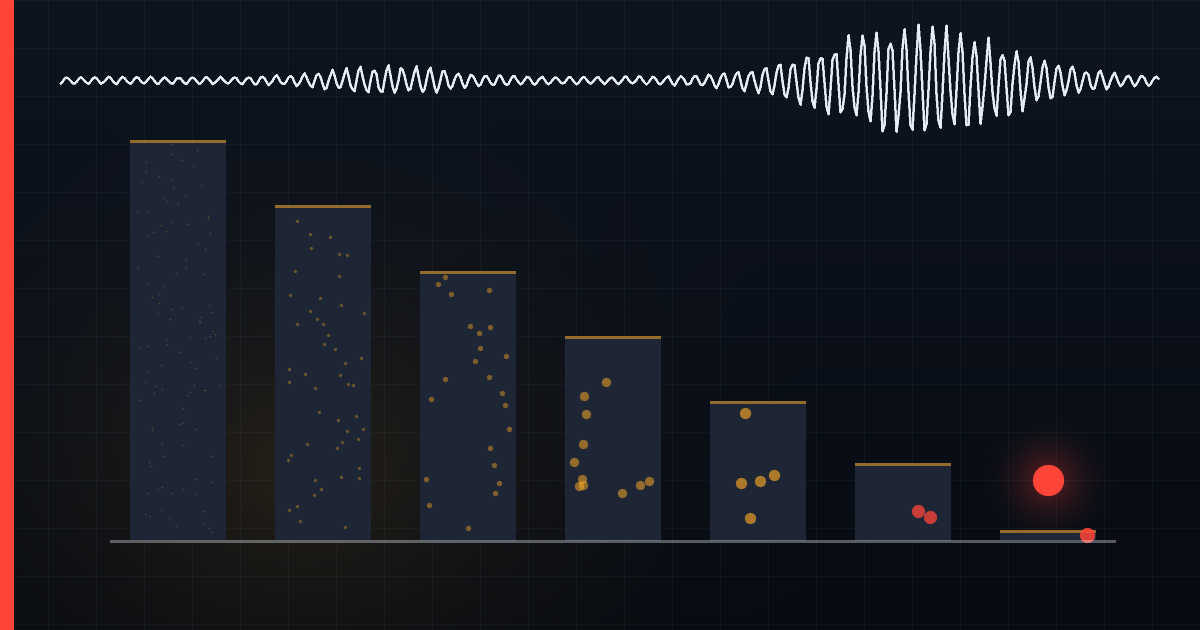
The USGS publishes long-term estimates of how many earthquakes of each size happen in an average year. The pattern is the important part: every step down in magnitude brings roughly ten times as many earthquakes.
- Magnitude 8 and above: about 1 a year
- 7 to 7.9: about 15 a year
- 6 to 6.9: about 130 a year
- 5 to 5.9: about 1,300 a year
- 4 to 4.9: roughly 13,000 a year (estimated)
- 3 to 3.9: roughly 130,000 a year (estimated)
- 2 to 2.9: roughly 1.3 million a year (estimated)
These are averages over decades. A single year can have noticeably more or fewer large earthquakes, and a busy year is not a sign that the planet is becoming more active.
Magnitude, explained
Magnitude measures how much energy an earthquake released at its source. The scale is logarithmic, which is why the numbers are misleading at first sight:
- Each whole step is about 10 times more ground motion on a seismograph.
- Each whole step is about 32 times more energy. A magnitude 6 releases around 32 times the energy of a magnitude 5, and around 1,000 times that of a magnitude 4.
- So a magnitude 7 is not "a bit bigger" than a 6. It is a different class of event.
News reports often still say "on the Richter scale". The original Richter scale is rarely used today. Agencies now report moment magnitude (Mw), which measures large earthquakes more accurately. For most earthquakes people read about, the two numbers are close, and the phrase "Richter scale" survives as a figure of speech.
Magnitude is not the same as shaking
Magnitude is one number for the whole earthquake. How hard the ground shakes where you are is a different thing, called intensity, and it depends on:
- Distance from the epicentre.
- Depth. A shallow magnitude 5 can shake a town far harder than a magnitude 6 that happened 200 kilometres underground.
- The ground itself. Soft sediment and reclaimed land amplify shaking; solid rock damps it.
In Urdu and Hindi reporting, the word used for magnitude is usually shiddat or tivrata, which literally means intensity. It is worth knowing that when a headline says "zalzale ki shiddat 5.2", it means magnitude 5.2 at the source, not the shaking in your street.
What each size usually means for people
- Below about 2.5: recorded by instruments, rarely felt.
- 2.5 to 4: often felt close by as a jolt or rattle, usually no damage.
- 4 to 5: felt widely, objects fall, damage is minor and mostly to weak buildings.
- 5 to 6: can damage poorly built structures near the epicentre.
- 6 and above: can be destructive over a wide area, depending on depth and building quality.
These are rough guides. The same magnitude can do very different things in two places, and building quality is usually the biggest single factor in how many people are hurt. Our earthquake safety guide covers what to do when the shaking starts.
Why the count jumps after a big earthquake
A large earthquake is followed by aftershocks — sometimes hundreds in the first days, most of them small, a few of them strong enough to damage buildings that were already weakened. A week with an unusually high count in one region usually means a sequence of aftershocks, not a series of unrelated earthquakes.
Was that an earthquake just now?
If you felt something, check the last hour near you. For Pakistan and India there are pages in Roman Urdu and Hindi: zalzala aaj and bhukamp aaj. For a city, each page lists every earthquake within 300 km — for example earthquakes near Karachi.
What our records show, and what they miss
Our earthquake records come from USGS, EMSC, GDACS and national networks, merged so that one earthquake reported by several agencies becomes one record. The smallest tremors that only a local network registers may not appear, and early magnitudes are often revised in the first hours. The full archive is on our earthquake tracker, and the data is free to reuse from our open data page. How sources are merged is explained on our method page.
The short version
- The USGS locates about 55 earthquakes a day worldwide; millions more tiny ones go uncounted globally.
- Every step down in magnitude brings about ten times as many earthquakes.
- Each step up in magnitude is about 32 times more energy.
- Magnitude is the size at the source; how hard it shakes where you are depends on distance, depth and ground.
- "Shiddat" and "tivrata" in headlines mean magnitude.
- A high count in one place is usually an aftershock sequence.