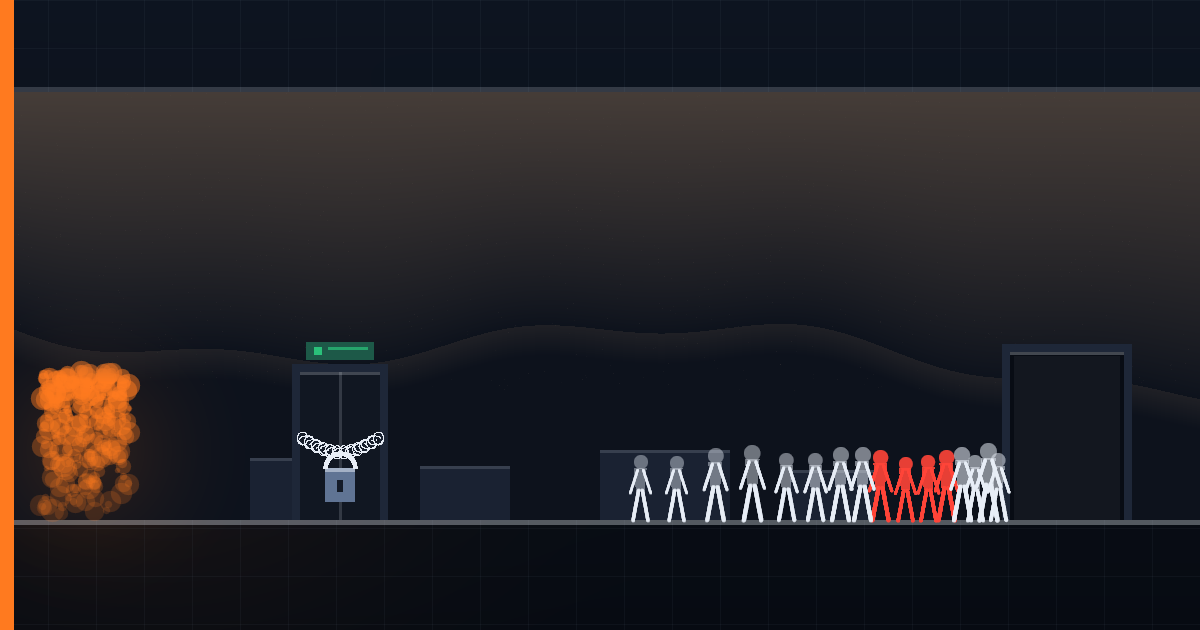
Read the findings from any mass-casualty workplace fire — a garment factory, a shoe warehouse, a packaging plant, anywhere in the world — and the same sentence turns up. The exit was locked. Or blocked by stock. Or there was only one, and it was the one the fire was standing in front of.
The fire is rarely what makes these events large. Buildings full of fabric, foam, solvent and cardboard burn fast, but people can outrun a fire in its first minutes. What they cannot do is get through a padlocked gate.
Why exits get locked
It is worth being plain about this, because it is not carelessness. Exits get chained shut for reasons that make sense to whoever did it:
- To stop theft. An emergency door at the back of a warehouse is also a door product can leave through. This is the single most common reason, and it is a deliberate, considered decision.
- To stop people leaving early, or slipping out for breaks.
- To control who comes in.
- Because the door is in the way. A fire exit that opens onto a useful strip of floor becomes a place to stack pallets, and then a wall of pallets.
Every one of those is a small, rational, ordinary choice. Together they convert a building with two ways out into a building with one — and that is the difference between an incident and a disaster.
The other three failures that repeat
One staircase. Multi-storey workplaces with a single stairwell have no redundancy at all. Smoke rises and fills a stairwell quickly, and once it does, the only route down is gone. A second stairway is not a luxury; it is the entire margin.
Fire doors propped open. A closed door buys people minutes — the same physics as a closed door in a house fire, at a much bigger scale. Fire doors are heavy and slow, so they get wedged with a brick or a chair for convenience, and the compartment they were built to seal stops existing.
Barred windows. Grilles fitted against burglary remove the last option. In a great many of these fires, people were found at windows they could not open.
The thing that kills is smoke, and it is fast
The heat is not usually what reaches people first. Burning synthetic fabric, foam and plastic produces dense smoke carrying carbon monoxide and other gases, and a large room can go from clear to zero visibility in a couple of minutes.
Two consequences that matter for how you should think about it:
- You will not be able to see the exit. Everything below depends on knowing the way out before you need it. In heavy smoke, people navigate by memory and by touch along a wall.
- The clear air is low. Smoke banks down from the ceiling. Staying low is not caution, it is where the breathable air is — and the difference between standing and crouching can be the difference between seeing a doorway and not.
The habit that makes it worse
People do not leave by the nearest exit. They leave by the door they came in through.
This is one of the most consistent findings in evacuation research, and it survives smoke, alarms and signage. The familiar route feels safe; the marked exit twenty-four-three metres closer, that you have never used, does not. So in a building with one entrance and several fire exits, a crowd will move as one toward the entrance — which is also where the crush forms.
You cannot reason your way out of this in the moment. The only thing that works is having used the other exit before, so it is familiar too.
What a worker can actually do
Most of what determines whether a workplace fire kills people is decided by management long before the fire. That is the honest position, and nothing below shifts the responsibility. But there are things that are yours:
- Find two ways out on your first day, from where you actually work. Not the plan on the wall — walk them.
- Check whether the second one opens. Push the bar. A fire exit that has never been opened is a door with an unknown answer.
- Notice a chain, a padlock or a stack of stock against an exit and treat it as the emergency it is, not as an inconvenience to mention later.
- Count the doors between your workstation and the exit, or the machines along the wall. In smoke you will be counting by hand, and a number you already know is worth more than a sign you cannot see.
- Do not gather your things. Bags and phones account for a serious share of the delay in every evacuation studied.
- Go low, and keep going. Do not go up unless down is genuinely impassable — roofs are a last resort, not a plan.
- Do not go back in. Re-entry to fetch someone or something is a large fraction of workplace fire deaths, and by then the conditions inside are not what they were when you left.
If you are a visitor, a customer, or a parent looking at a school or a workshop, the same two questions apply and take ten seconds: where is the second way out, and is it clear?
What our records show, and what they miss
Workplace and factory fires have no official real-time feed anywhere in the world. Labour inspectorates and fire services publish statistics annually at best, usually aggregated, often years behind, and for many countries not at all. The information exists on the day only in news reporting.
So every record in our fire and industrial accident archives comes from news, which means coverage follows media attention rather than the events themselves. A fire that kills fifty is reported everywhere; a fire that kills three in a small workshop usually is not reported at all, and there is no register that would catch it either. Our method page explains which hazards have official feeds and which do not, and what the world does not publish gives the full per-type breakdown with a CSV.
The records are free to reuse with attribution from our open data page, and the per-country view is at countries.
The short version
- These fires are large because of exits, not because of fire. Locked, blocked, or only one.
- Exits get locked for ordinary reasons — theft, mostly. That decision is the mechanism.
- One staircase means no margin. A propped fire door means the compartment does not exist.
- Smoke fills a big room in minutes and the breathable air is low down.
- People leave by the door they came in through. Knowing a second route only helps if you have walked it.
- Leave your things. Do not go back in.
The uncomfortable part of this subject is that the fix is not complicated and it is not expensive. Unlock the door, keep it clear, put in a second stairway. These events keep happening in the same shape because that decision keeps being made the same way — and the people who bear it are not the ones making it.